Common Environmental Compliance Mistakes in Industrial Companies
Environmental compliance challenges often arise not because companies intentionally violate regulations, but because environmental management systems are not properly structured.
3/16/20263 min read
Common Causes of Environmental Non-Compliance in Industrial Companies
Environmental compliance is a critical responsibility for industrial companies. In Indonesia, environmental regulations require companies to manage environmental impacts, monitor pollution, and report environmental performance regularly.
However, in practice, many companies still face compliance challenges. These issues are generally not due to intentional violations, but rather a lack of understanding, weak environmental management systems, or operational oversight.
These mistakes can lead to administrative sanctions, operational disruptions, reputational damage, and financial risks.
Below are some common environmental compliance issues frequently found in industrial companies:
1. Incomplete or Outdated Environmental Permits
One of the most common issues is operating without complete or updated environmental permits.
Industrial companies are required to have documents such as:
Environmental Impact Assessment (AMDAL)
Environmental Management and Monitoring Efforts (UKL-UPL)
Environmental Approval integrated with business licensing
These requirements are regulated under:
Law No. 32 of 2009 on Environmental Protection and Management
Government Regulation No. 22 of 2021
Problems often arise when companies expand their production capacity or modify operations without updating their environmental documents.
Example case:
A company increases its production capacity but does not update its environmental approval. During an inspection, authorities find a mismatch between the approved capacity and actual operations, which may result in sanctions.
Solution:
Regularly review environmental permits and ensure they align with current operational conditions.
2. Poor Wastewater Management
Wastewater management is one of the most closely monitored aspects of environmental compliance.
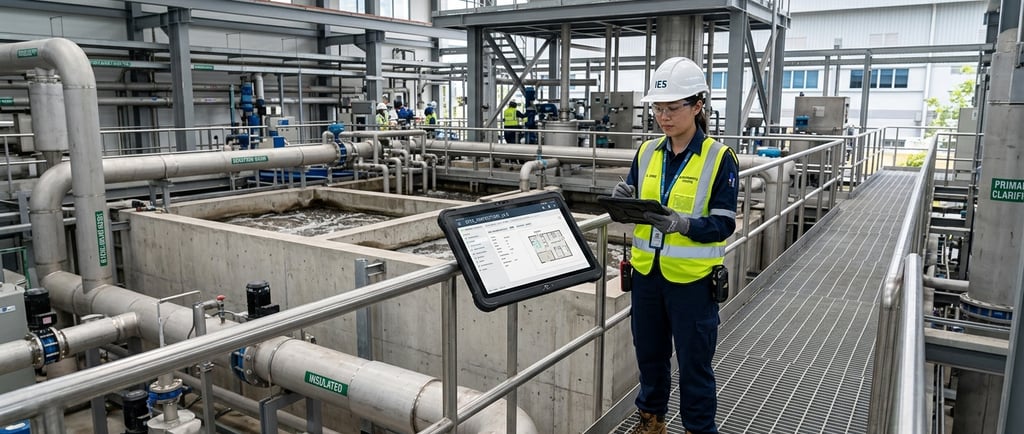
Many industries already operate wastewater treatment plants (WWTP), but still face issues such as:
Suboptimal treatment performance
Weak operational control
Lack of monitoring and maintenance
Wastewater discharge must comply with quality standards regulated under Government Regulation No. 22 of 2021.
Example case:
Inconsistent WWTP performance leads to certain parameters exceeding discharge limits. If not addressed promptly, this may result in regulatory sanctions.
Solution:
Ensure proper WWTP operation and implement reliable monitoring systems such as SPARING (Continuous Online Wastewater Monitoring System).
3. Weak Hazardous Waste Management
Hazardous waste (B3 waste) must be properly handled, stored, transported, and reported.
Common issues include:
Improper storage practices
Incomplete labeling and documentation
Exceeding temporary storage time limits
These requirements are also regulated under Government Regulation No. 22 of 2021.
Example case:
A company stores hazardous waste beyond the permitted period without proper authorization. During inspection, authorities find that the storage facility does not meet technical standards, leading to sanctions.
Solution:
Implement proper hazardous waste management procedures, including safe storage, accurate documentation, and timely transportation to licensed facilities.
4. Inconsistent Environmental Monitoring and Reporting
Monitoring and reporting are essential components of environmental compliance.
Common problems include:
Incomplete monitoring data
Irregular monitoring schedules
Delayed reporting
These obligations are regulated under Law No. 32 of 2009.
Example case:
A company conducts environmental monitoring but fails to submit periodic reports. During evaluation, this becomes a compliance issue.
Solution:
Establish structured monitoring systems and maintain proper environmental documentation to ensure accurate and timely reporting.
5. Lack of a Structured Environmental Management System
Many companies still lack an integrated environmental management system.
Environmental compliance involves multiple aspects, including:
Pollution control
Environmental monitoring
Reporting
Waste management
Resource efficiency
Without clear structure and responsibilities, implementation becomes fragmented and inconsistent.
Environmental performance is also evaluated through the PROPER program by the Ministry of Environment and Forestry.
Solution:
Develop a structured environmental management system with clear procedures, defined responsibilities, and regular internal audits.
Conclusion
Environmental compliance challenges often arise not because companies intentionally violate regulations, but because their management systems are not properly structured.
Issues such as incomplete permits, poor wastewater management, weak hazardous waste handling, and inconsistent reporting can expose companies to significant risks.
By strengthening environmental management systems, improving monitoring practices, and maintaining regulatory awareness, companies can reduce compliance risks while improving operational performance.
Environmental compliance is not only about avoiding sanctions, but also about enhancing efficiency, strengthening corporate reputation, and supporting long-term business sustainability.
Need Support to Improve Your Environmental Compliance?
Every company faces unique challenges in managing environmental responsibilities. Without a structured system and the right support, compliance risks may continue to occur.
Ensindo supports your company in:
Ensuring compliance with environmental regulations
Strengthening environmental management systems
Improving monitoring and reporting quality
Supporting better PROPER performance
With a practical and structured approach, we help ensure that environmental programs are not only well-designed but also effectively implemented in daily operations.
Discuss your company’s needs with the Ensindo team today.
PT ENVITAMA SOLUSI INDONESIA
PT ENVITAMA SOLUSI INDONESIA @2025
Addresses :
Taman Setiabudi Indah 2 Blok 2 No. 22 Medan Sunggal. Medan Sumatera Utara

Chat with Our Marketing :